



A hoodie is the easiest thing in a wardrobe to buy badly. On a product page they all look identical: black, hood, kangaroo pocket, done. Six months later one is still holding its shape and the other has pilled across the forearms, gone slack at the cuffs and faded to that patchy charcoal that says it has been through the dryer too many times.
The difference is not the logo on the chest. It is fleece type, fabric weight, and roughly five construction details you can check before you spend a cent. This is how to read a hoodie properly, whether you are buying ours or someone else's.
Pullover or zip: decide this first
Zip hoodies are the easier layer. They come off without dragging your t-shirt up with them, they vent when you overheat, and they work as a light jacket over a tee. That is a real use case and worth buying for.
Pullovers are warmer for the same fabric weight, because there is no zip line splitting the front panel and no cold seam running down your chest. They also hold their shape longer, since a zip is almost always the first piece of hardware on a hoodie to fail, and a failed zip ends the garment regardless of how good the fleece is.
Our range is pullover only, and that is deliberate. For training and for a blacked-out silhouette, an unbroken front panel is warmer, cleaner and has one less thing to break. If you want a layer you will be opening and closing all day, buy a zip. If you want something that goes on before a session, comes off around set three and carries straight into the street rotation, a pullover is the better piece of kit.

"Fleece" is not one fabric
This is where most of the price difference hides, and where almost nobody looks. Three broad tiers:
- Cheap 100% polyester fleece. Warm, light, very cheap to make. It pills quickly under a backpack strap or a car seat, holds training odour, and always feels slightly plasticky against skin. This is what most discount hoodies are.
- 100% cotton fleece. Excellent hand-feel and breathability, but heavy when damp, slow to dry, and prone to shrinking and sagging out of shape if it has not been properly pre-shrunk.
- CVC (cotton-rich) fleece. A cotton-majority blend with polyester carried through it. You get the cotton face for feel and breathability, and the polyester for shape retention, faster drying and resistance to stretching out at the cuffs and hem.
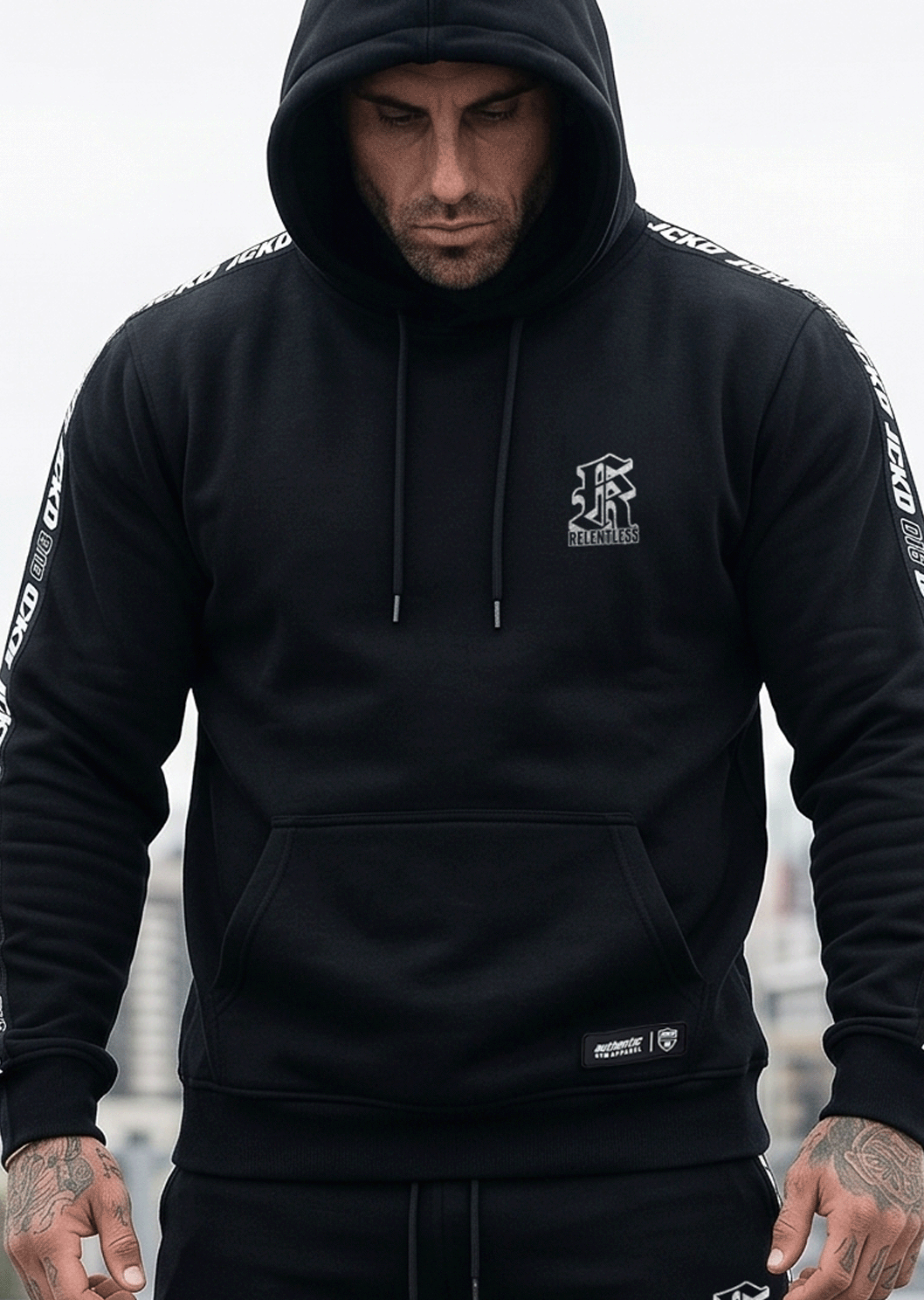
The third is what we build with. The Relentless Hood runs a 230 GSM anti-pill CVC fleece, cotton-rich and pre-shrunk. The heavier 6018 Outlift Vertical Hood uses a 350 GSM anti-pill CVC at 80% cotton and 20% recycled polyester. The Relentless Scribe Hood sits alongside the Relentless at 230 GSM, in a 70/30 cotton-polyester blend.
Look for the words anti-pill specifically. Pilling is the single most common reason a hoodie starts looking cheap while it is still structurally fine, and an anti-pill finish is a manufacturing decision, not something you can fix later with washing habits.
The weight ladder: what 230 and 350 actually mean
Hoodie fleece is measured in GSM, grams per square metre, the same scale used for tees. Higher is not automatically better, it is a different garment for a different job.
- Around 230 GSM. Mid-weight. Warmth and structure without bulk, which makes it the year-round option: layer it over a tee on a cold start, peel it off mid-session, wear it out afterwards without cooking. This is the weight most people should own first, and it is where the Relentless sits.
- Around 350 GSM. Heavyweight. Noticeably more substantial in the hand, holds a heavier drape, and earns its place on genuinely cold mornings, outdoor sessions and unheated garage gyms. The 6018 Outlift hoods sit here.
If you want the full explanation of the scale and how it maps across tees, singlets and fleece, we broke it down in what GSM means in gymwear.
Five construction details that decide how long it lasts
- A lined hood with a proper drawcord. An unlined hood collapses flat the moment you put it up, which makes it decoration rather than function. Lining gives it body so it stays up.
- Ribbed cuffs and hem. Ribbing is what pulls the sleeve back to shape after you have shoved it up your forearm between sets. Without it, cuffs stretch out permanently within a couple of months and the whole garment starts looking tired from the wrists in.
- Twin-needle stitching. Two parallel rows of stitching instead of one, through the seams that take load. It is slower and more expensive to sew, and it is the difference between a seam that holds and a seam that gapes.
- Pre-shrunk fabric. Fleece that has not been pre-shrunk moves after the first few washes, usually shorter in the body and tighter through the sleeves. Pre-shrinking means the hoodie you try on is the hoodie you keep.
- Inset sleeves and a clean shoulder line. A sleeve set properly into the shoulder holds an athletic shape through the upper body instead of sloping off it. You notice this most on lifters, where a badly cut shoulder makes a good back look narrow.
Where cheap hoodies fail first
In roughly this order: the cuffs go slack, the forearms and the area under a backpack strap start pilling, the hood loses its shape and lies flat, the shoulder seam puckers, and the black fades unevenly. None of those are wear-and-tear inevitabilities. Every one of them traces back to a spec decision made before the garment was cut.
Washing habits matter too, and they are the part you control. Cold wash, inside out, no fabric softener, and air dry rather than tumble. We covered the full routine in the gym clothing care guide, and it applies double to fleece.
Fit, in one paragraph
A hoodie you train in needs room through the shoulders and chest, not extra length in the body. Raise both arms overhead: if the hem climbs to your ribs, it is cut too tight through the upper body regardless of what the size label says. It should layer over a tee without pulling, and the sleeves should push up cleanly. For the seasonal layering side of this, including what goes under a hoodie on a cold NZ morning, see our guide to picking a hoodie built for winter training.
Frequently asked questions
What GSM should a men's hoodie be?
Around 230 GSM is the year-round mid-weight and the best first hoodie for most people: warm and structured without bulk. Around 350 GSM is a heavyweight for genuinely cold conditions. Below roughly 200 GSM you are buying a long-sleeve with a hood attached.
Is a cotton-polyester hoodie better than 100% cotton?
For a hoodie, usually yes. Pure cotton fleece feels excellent but stretches out of shape, holds damp and dries slowly. A cotton-rich CVC blend keeps the cotton face against your skin while the polyester holds structure at the cuffs, hem and shoulders. That is why every hoodie we make is CVC rather than 100% cotton, even though our tees are combed cotton.
Do you make zip hoodies?
Not currently. Everything in the range is a lined pullover, chosen for warmth, a clean unbroken front and one less component to fail. If a zip is non-negotiable for how you will wear it, buy the zip, just apply the same fleece and construction checks above.
How do I stop a hoodie from pilling?
Start with an anti-pill fleece, because that decision is made at the mill and cannot be undone. Then wash cold and inside out, skip the fabric softener, avoid washing fleece with towels or denim, and air dry. Most pilling is friction, so the less abrasion in the drum, the longer it stays smooth.
The short version
Check the fleece type, check the GSM, check for a lined hood, ribbed cuffs, twin-needle stitching and pre-shrinking. Five things, thirty seconds, and it will tell you more about a hoodie than any amount of product photography.
Ours are built to pass that check: browse the RTLS hoodie range, or see what the rest of the kit looks like in The Rotation. Premium fleece, designed in Auckland, shipped fast across NZ and Australia.